
Key Takeaways
- Process Beats Habit: Doing prior authorization and having a prior authorization workflow are not the same thing. The difference shows up directly in prior auth approval rates, turnaround times, and staff capacity.
- Four Stages, Four Owners: A reliable specialty PA workflow moves through Intake, Submit, Track, and Complete, each with a clear owner and a defined handoff to the next stage.
- Most Breakdowns Start at Intake: When eligibility, benefit verification for specialty medications, and clinical documentation aren’t assembled before submission, denials follow. For example, many Medicare Advantage denials involved services that met coverage rules but were rejected over documentation.
- Tracking Is Where Time Disappears: Without a single owner or a real-time follow-up cadence, requests stall. Yet, data shows over 80% of appeals are overturned.
- The Workload Is Burdensome: Practices spend an average of 13 hours per week on prior authorization. Structure and electronic prior authorization workflows are what make that time productive.
Come Monday morning, the authorization queue tells you everything you need to know about your prior auth system. At a typical specialty practice, one request is still waiting on last week’s benefit check, while another comes back denied over a missing signature no one caught. The third is fine, but only because the coordinator who knows that specific payer’s rules happened to be in. Each outcome traces back to the same flaw: The specialty drug prior authorization process changed depending on who picked up the request and what they happened to know.
That inconsistency is an important tell. It’s the difference between a practice that simply does prior authorization and one that runs a defined specialty prior authorization process: the same steps, in the same order, with the same owner accountable at each stage, regardless of who’s at the desk.
A lack of consistent workflows has serious ramifications outside of the immediate back office, surfacing negatively in prior auth approval rates, turnaround times, and how much of the team’s week disappears into payer portals. And it only widens with growth: Every new patient adds a unique payer, a plan, and another set of payer-specific authorization requirements to track.
A specialty PA workflow is the operational infrastructure that determines whether a practice can treat patients predictably and keep doing it at scale. This guide maps what that workflow looks like from intake to first treatment, and where the gaps that produce denials tend to hide.
Why Specialty PA Workflows Break Down
Informal approaches fall through because specialty settings overwhelm unstructured systems. Three pressures do the lion’s share of the damage: the sheer volume of active authorizations, the complex variability of payer-specific authorization requirements, and the rigorous clinical documentation for specialty PA required for high-cost specialty medications like biologics and infused therapies.
When the process lives entirely in one person’s head, outcomes depend heavily on who’s working that day. A request gets submitted without a current benefit check. A critical follow-up window passes unnoticed. A denial that could have been prevented at intake lands in the queue weeks later. None of this is exotic. Rather, it’s the predictable result of relying on tribal knowledge instead of a repeatable sequence.
A Start-to-Finish Map of the Specialty Prior Authorization Process
A reliable specialty prior auth workflow moves through four distinct stages. Map your current operations against them and the gaps tend to announce themselves.
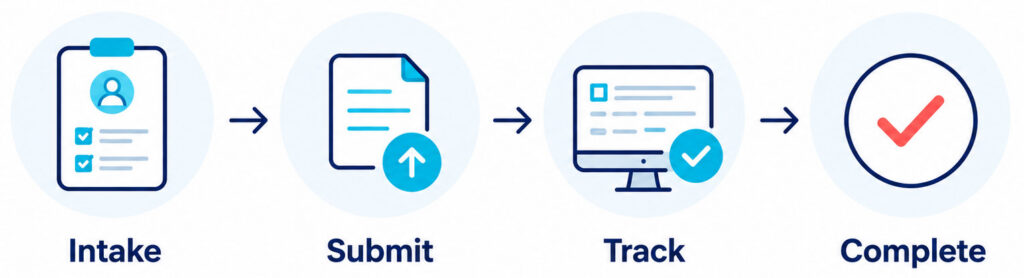
Intake
- What to do: Confirm eligibility before any clinical work begins, then complete the benefit verification for specialty medications and assemble the necessary clinical documentation for specialty PA.
- Who owns it: Front-office or intake coordinator.
- What a breakdown looks like: A request moves forward on stale coverage data or a thin chart, guaranteeing rework later. This is exactly the gap federal regulators are targeting: CMS’s 2026 proposed rule on interoperability would push drug-specific coverage and documentation requirements directly into APIs, turning “know the requirement before you submit” from a best practice into a baseline expectation.
Submit
- What to do: Build and send the authorization request with every payer-specific requirement met, then run a final quality check for one of the most common causes of instant rejection: missing signatures.
- Who owns it: PA coordinator or specialty pharmacy liaison.
- What a breakdown looks like: An otherwise approvable request bounces on a technicality the practice never sees, restarting the administrative clock. As one Forbes analysis contends, documentation quality is a clinical operations problem—and with decision windows often as short as 72 hours, there’s little margin to absorb a restart like this. Given that practices already spend an average of 13 hours a week on prior authorization, every avoidable resubmission is expensive.
Track
- What to do: Monitor status utilizing real-time prior authorization status tracking, maintain a defined follow-up cadence, and, when a denial returns, route it immediately into peer-to-peer review or a Level 1 appeal so the request stays in the workflow instead of falling off it.
- Who owns it: A single named tracker acting as the primary accountable point person.
- What a breakdown looks like: Requests stall in payer limbo. This is where the most time leaks, and the data shows why it matters: A KFF analysis found only 11.5% of denials are appealed, yet 80.7% of those appeals succeed.
Complete
- What to do: Move from approval to first treatment. Communicate the authorization’s effective dates and units authorized directly to scheduling and billing so no one treats a patient outside the approved window.
- Who owns it: PA coordinator handing off to scheduling and billing.
- What a breakdown looks like: The approval arrives and then sits, or a patient is scheduled past the auth window. Either way, the practice ends up back at square one—re-verifying a benefit that was already confirmed, or resubmitting a request that was already approved, because the internal handoff to scheduling and billing never closed the loop.
Where Most Practices Are Losing Time
Two stages account for most of the lost time, and both fail for the exact same reason: unclear ownership.
Intake is the first. When no one’s clearly responsible for compiling clinical documentation for specialty PA before submission, it gets assembled inconsistently (or after submission rather than before), and the practice trades a few minutes of proactive prep for days of downstream rework. The OIG’s review of Medicare Advantage denials makes the cost concrete: Many rejected requests were for services that met coverage rules but were turned down purely over documentation gaps.
Track is the second. When status monitoring is scattered across whoever has a free moment, follow-up becomes optional and denials quietly age out of the appeal window. A single owner and a fixed cadence turn tracking from an administrative afterthought into a discipline.
Compare your own process against these two stages honestly. Reflecting on these touchpoints can help you find the seams where your specialty prior authorization process leaks time.
Mapping Your System for Specialty Prior Auths
The Intake–Submit–Track–Complete sequence isn’t a finished system on its own, but instead a diagnostic tool. Laid over your current operation, it turns Monday morning’s queue from a guessing game into a checklist: which stage is this request stuck in, and who owns getting it unstuck? That’s the question an informal process can’t answer and a defined one always can.
Modern electronic prior authorization workflows remove the manual guesswork. CareTria Provider Connect is built to streamline this entire lifecycle, handling automated benefit verification, submission compliance, and real-time status tracking in one centralized platform, with ownership built into each handoff instead of left to whoever’s at the desk.
See how CareTria Provider Connect supports the full specialty prior authorization process.
FAQs About Specialty PA Workflows
What’s the difference between doing prior authorization and having a prior authorization workflow?
Doing PA means completing individual requests reactively as they come. Having a workflow means following a defined, repeatable sequence, with clear ownership at each stage, so your prior authorization approval rates don’t depend on who’s working that day.
What are the main stages of a specialty prior authorization process?
A secure workflow consists of four specialty drug prior authorization process steps:
- Intake covers eligibility, benefit verification for specialty medications, and documentation.
- Submit is a complete, payer-compliant request meeting all unique prior authorization submission requirements.
- Track is real-time prior authorization status tracking, follow-up, and appeals.
- Complete is the handoff to scheduling and billing for first treatment.
Where do specialty practices lose the most administrative time?
Usually at Intake and Track. Clinical documentation assembled inconsistently, or after submission rather than before, creates downstream rework. And tracking with no single owner lets denials age out of the appeal window.
Why do clean, clinically appropriate requests still get denied?
Because approval depends on operational precision just as much as clinical merit. A request can be medically sound and still bounce on a missing signature, an outdated payer-specific authorization requirement, or documentation that doesn’t match the plan’s current criteria. These are all examples of process gaps that can be healed with the right system.
Is it worth appealing a denied specialty medication?
Often, yes. A large share of denials stem from documentation or submission issues rather than a true coverage problem, which means many are correctable on appeal or resubmission. The bigger win is catching those issues at Intake and Submit so fewer denials happen in the first place.