Every day a patient waits for a benefit investigation to be completed is a day they are not on therapy. For specialty medications, that wait can cascade into weeks — and weeks can become permanent abandonment. Automation is changing this equation dramatically
In specialty pharmacy and patient access, benefit investigation is the first major gate a prescription must pass through before a patient can begin treatment. It determines coverage, identifies prior authorization requirements, surfaces available cost-sharing programs, and routes the prescription to the appropriate fulfillment channel. Done manually, it is slow, error-prone, and expensive. Done with modern automation, it can be nearly instantaneous — and the downstream effects on therapy initiation rates are substantial.
What manual benefit investigation costs
Traditional benefit investigation involves a benefits coordinator — often at the prescriber’s office, hub, or specialty pharmacy — calling the patient’s insurance company, navigating an IVR, waiting on hold, and manually recording the response. For specialty medications that fall under both medical and pharmacy benefits, this process may need to be repeated for each benefit type, with different payer contacts.
A single thorough manual benefit investigation can take 20–45 minutes on an average day and hours during annual reverification season. For a hub or specialty pharmacy managing hundreds of new patient starts per week, the staffing costs alone are significant. Beyond cost, manual processes introduce inconsistency: the completeness and accuracy of the information gathered depends heavily on individual staff skill and the quality of the payer interaction.
What electronic benefit verification (eBV) delivers
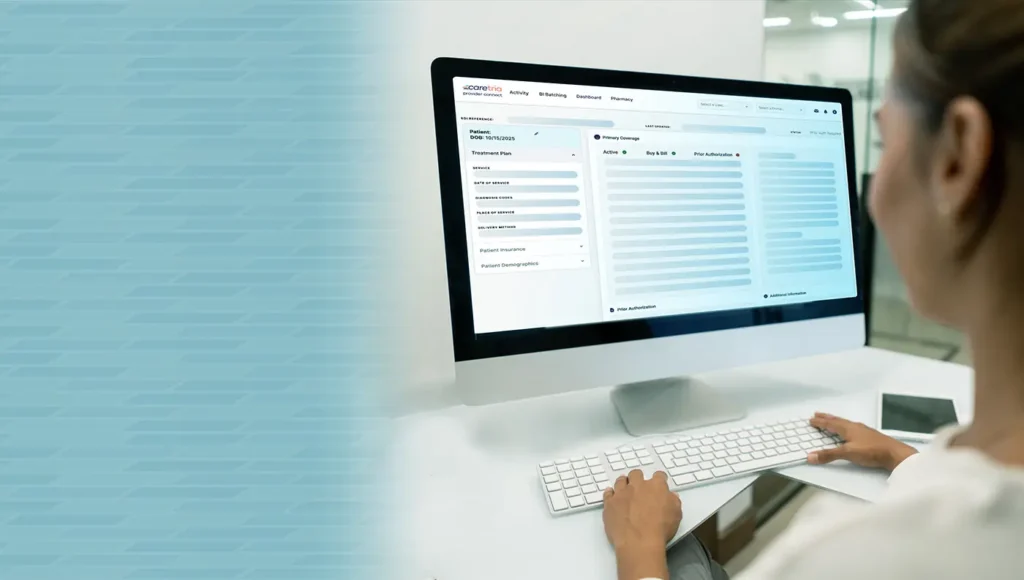
Electronic benefit verification replaces manual calls and portal navigation with automated, real-time queries to payer systems. A well-designed eBV platform returns benefit information — coverage status, tier, cost-sharing, PA requirements, formulary position — in seconds rather than minutes or hours, directly within the provider or hub workflow.
The business impact compounds across multiple dimensions:
- Faster therapy initiation: patients get coverage information while they are still in the office or on the phone with the hub
- Higher conversion rates: fewer patients abandon treatment during the coverage gap
- Lower administrative cost: staff handle exceptions rather than routine verifications
- Greater accuracy: automated queries reduce transcription errors and missed information
- Consistent data: every investigation follows the same process, producing comparable outputs
➤ Case study: PAP operational transformation→
What to look for in an eBV solution
Not all eBV platforms are equivalent. When evaluating options, pharma manufacturers and hub operators should look for:
- Payer breadth — does the platform cover your patient population’s insurers? CareTria’s network spans 1,400+ payers
- True direct payer connection versus an AI agent call
- Medical and pharmacy benefit coverage — can it check both simultaneously for injectable/infused therapies?
- Speed — what percentage of investigations return in real-time? CareTria Provider Connect achieves 85% in under 60 seconds
- Workflow integration — does it require a separate login or embed directly in the provider’s existing systems?
- Data quality — how complete and reliable is the output, and how are exceptions handled?
From benefit verification to therapy initiation
eBV is powerful on its own, but its full value is realized when it is connected to the downstream steps of therapy initiation: prior authorization submission, copay enrollment, and pharmacy fulfillment routing. Platforms that integrate these steps in a single workflow eliminate the handoff delays that occur when separate vendors manage separate functions.
CareTria’s approach treats eBV not as a standalone tool but as the first step in a connected, automated initiation sequence — one that can take a patient from prescription to therapy faster than any fragmented model can.
➤ Learn about CareTria’s eBV platform →
Measuring benefit investigation cycle time in your program? CareTria’s eBV platform returned 85% of benefit verifications in under 60 seconds across 1400+ payers – connected to ePA and fulfillment in one workflow. Let’s talk.