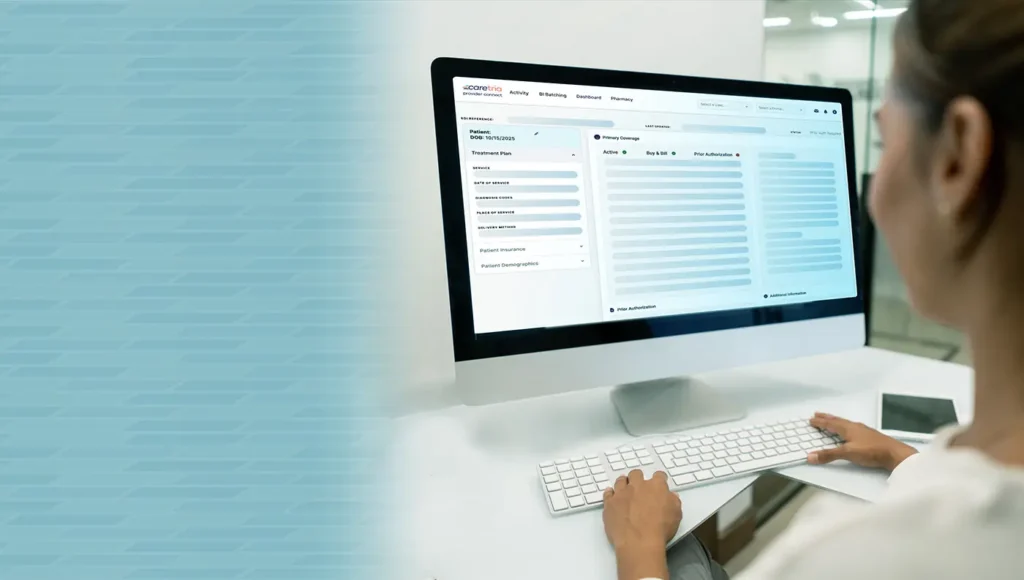
The fully loaded cost of a traditional, manually operated HUB is rarely visible on a single line in a pharma commercial budget. It is distributed across staffing, vendor fees, delayed starts, abandoned prescriptions, and gross-to-net drag — and it is almost always underestimated.
Specialty pharma Hub services — the patient support infrastructure that sits between a prescription and therapy initiation — are widely acknowledged as necessary for specialty drug programs. What is less frequently examined is exactly how much manual HUB operations cost, and how much of that cost is recoverable through automation and better integration.
The answer, in CareTria’s experience across its pharma client base, is that the recoverable cost is substantial — and that manufacturers who examine their HUB operations with clear-eyed precision routinely find more efficiency opportunity than they expected.
What HUBs do — and why it gets complicated
A specialty drug hub exists to coordinate the complex set of activities required to get a patient from prescription to therapy: benefit verification, prior authorization support, copay enrollment, patient education, and pharmacy routing. For high-cost, complex therapies, this coordination function is genuinely necessary — patients and providers cannot navigate it reliably on their own.
The problem is not that hubs exist. It is that many hubs operate primarily through manual processes: phone calls, faxes, spreadsheet tracking, and manual case management. Every manual step is a potential delay, a potential error, and a staffing cost that scales linearly with volume — rather than efficiently as automation would allow.
The visible costs
Staffing
A traditionally operated HUB requires significant staffing: case managers, benefits coordinators, patient educators, and administrative support. These are recurring operational costs that grow with program volume. When automation absorbs routine tasks — like real-time benefit verification — the staffing requirement changes fundamentally. CareTria achieved a 46% staffing reduction for one pharma partner through automated enrollment and verification, while simultaneously processing more cases faster.
Vendor management overhead
Many pharma companies run their HUB through a third-party vendor or a network of vendors. Managing those relationships — contracts, SLAs, data integration, quality audits — is itself a significant overhead. Fragmentation across multiple vendors compounds the cost: each handoff point is a management burden and a source of delay.
- 52% Faster annual verification with CareTria Automation
- 46% Staffing reduction for a major pharma HUB client
- 21% Reduction in enrollment processing denials after transition
The hidden costs
Delayed therapy initiation and prescription abandonment
The most significant cost of manual HUB operations is one that rarely appears in an operations budget at all: the revenue lost to delayed or abandoned prescriptions. Every day a case sits in a manual queue waiting to be processed is a day that increases the risk of abandonment. Research across specialty drug categories consistently shows that initiation rates decline as time-to-first-fill increases. The HUB is often the critical bottleneck.
Claim errors and re-work
Manual benefit verification and prior authorization submission produce more errors than automated processes. Every error that results in a claim denial generates re-work — more staff time, more vendor interaction, more delay for the patient. The direct cost of re-work is compounded by the patient experience damage it causes.
Gross-to-net drag
Inefficient specialty pharma HUB services affect gross-to-net in ways that are difficult to see individually but significant in aggregate. Delayed starts mean delayed revenue. Abandoned prescriptions mean zero revenue from clinical spend. Poor copay program enrollment means patients bearing costs they should not, which drives non-adherence and discontinuation.
The case for HUB integration
Beyond automation within the HUB, the next frontier of efficiency is integration — connecting the HUB directly with the provider platform, the pharmacy, and the 3PL in a single workflow. CareTria’s integrated approach means that benefit verification, prior authorization, enrollment, and fulfillment routing all happen in one connected system, eliminating the hand-off delays that multiply in fragmented models.
When did you last audit the true cost of your HUB operations? CareTria helps pharma manufactures replace manual HUB workflows with integrated automation that reduces cost, improves speed, and protects gross-to-net. Request a consultation at caretria.com/contact-us.