Optimizing Quality and Cost to Serve Through Provider Technology Integration
Moderator: Matt Wolf, Chief Commercial Officer, CareTria (pharmacist by background, 25 years in healthcare)
Panelists:
- Donna Walker – Takeda (specialty and retail products)
- Justin Tindle – Director of Software Development, CareTria (13+ years in the field)
Opening Context
Matt Wolf: The core question we’re exploring today: How do we improve and maintain quality while reducing cost by leveraging provider technology?
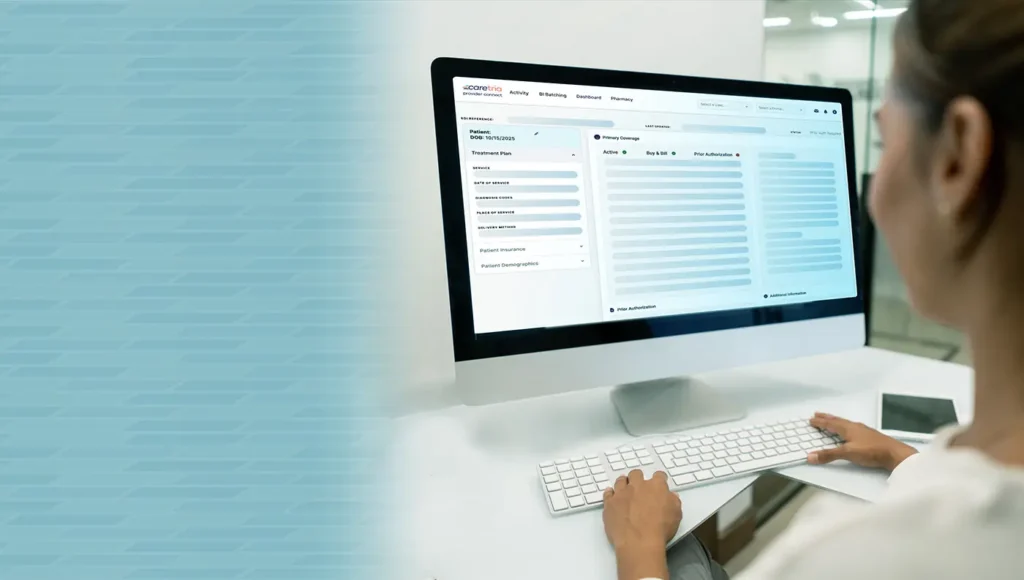
Provider technology companies have emerged to operate within the healthcare provider workflow — creating interfaces that reduce administrative burden, simplify patient enrollment in assistance programs and hubs, and connect to hub CRMs through standard API interfaces. The result: increased efficiency, less manual data entry, better analytics, faster time to treat, and fewer missing information gaps.
Current Challenges Facing PAP Programs
Donna Walker: The biggest challenge on my mind right now is alternate funding providers (AFPs). Identifying them efficiently is still a very manual, very time-consuming process — and that directly delays patients’ access to therapy.
“It adds cost to the operations. But we also see manufacturers changing their business rules, making them more restrictive — and unfortunately impacting some patients’ abilities who should be in PAP and have earned that.”
We’re also seeing uninsured patients running into increased hurdles with PAP programs that shouldn’t be affecting them at all.
Justin Tindle: From the service provider side, the biggest inhibitors are:
- Reliance on outdated technology — fax and phone workflows create missing information and require heavy manual follow-up
- Lack of automation with payer and PBM access, making real-time eligibility determinations nearly impossible
- Limited digital enrollment — if you’re not meeting providers and patients where they are, you’re adding friction and cost at every step
The Ideal Provider Experience (Today vs. Future)
Justin Tindle: Today, providers are dealing with repetitive, paper-based workflows — filling out forms, faxing, calling, and constantly following up because information is incomplete. The back-and-forth is a real burden.
The better version looks like this:
“A single portal that has access to many different products — fill out patient information, run an eligibility check, do an income check, submit the eRx, get the determination in real time. Status goes back to the provider and the patient. Rx is sent to the pharmacy, filled, shipped — all updated in real time. The patient is on therapy.”
And beyond that — all that data collected feeds into reporting and dashboards so manufacturers can actually understand their programs and optimize them.
Matt Wolf: From the pharmacy side, the gaps today are:
- Highly manual patient engagement (humans making phone calls)
- Minimal integration between the front-end hub and the fulfillment/pharmacy side
- Fulfillment that isn’t adaptable or scalable
The ideal future is a “next best action” model — a configurable process that guides the provider through the full access and affordability journey, with fulfillment connected to wherever the patient lands (commercial fill, bridge fill, starter dose, PAP, etc.).
“You’re connecting the fulfillment journey to the access decision.”
AI also plays a role here — particularly for lower-complexity patient interactions like refill status or address changes — freeing up human agents for higher-touch situations.
Donna’s Vision: The Ideal PAP Program
Donna Walker: My ideal program isn’t the future — it’s right now. It starts with a well-aligned set of access programs that aren’t built in silos.
“Only truly PAP patients are triaged to PAP. The business rules are aligned so we’re not having patients come to PAP because one piece of another program’s eligibility criteria isn’t being met — when in fact, it really isn’t a PAP patient.”
Too often, PAP receives the most difficult access patients because upstream programs have failed them — when a small tweak to another program’s rules (with legal and compliance oversight) would have been the right fit. The full access continuum needs to be thought out with flexibility to manage patients in the best program for their situation.
Key Metrics That Improve With Better Technology
(Justin Tindle & Matt Wolf)
- Reduced time to treat
- Fewer inbound calls (to both call center and pharmacy)
- Reduced cost to service
- Faster turnaroundtime on eligibility determinations
- Improved adherence rates (through texting, mobile apps, AI refill reminders)
- More patients on therapy
Final Advice for the Audience
Donna Walker:
“Stay connected to the patient-provider customer. Talk to the actual operations team — the people answering the phones — and ask them what they’re hearing. When they start to tell you a pattern, that’s your signal. KPI anomalies are opportunities to understand root cause, not just fix the surface.”
Also: challenge your suppliers. They’re seeing many programs; you only see the ones you manage. And pay attention to other industries — how does American Express handle its phone systems? What can you learn from your own physician’s office? Bring those lessons in.
Matt Wolf:
“Don’t look at your program in totality. Look at it in terms of modularity — identify where you’re seeing pain or opportunity, and pursue solutions. Integrations and APIs are standard now. Not one service provider is going to do everything great all the time. Challenge your vendors, and explore partnerships.”
Justin Tindle:
“Meet the provider and the patient where they are, at the point of care. Take your complex processes and figure out how to make them simpler. And recognize — it’s not going to be one company that solves this problem. It’s going to be all of us.”
Matt Wolf (closing):
“A lot of times we try to solve the problem at the PAP program or at the hub — but the problem starts at the provider level. Leveraging technologies that help the provider’s workflow means you are solving the problem where the problem presents. That’s where the real economies and efficiencies are.”
Panel recorded at an industry conference. CareTria provides provider-facing technology solutions for patient assistance programs and hub integrations.